
Spoofing vs Phishing: What Is the Difference and Why It Matters in 2026
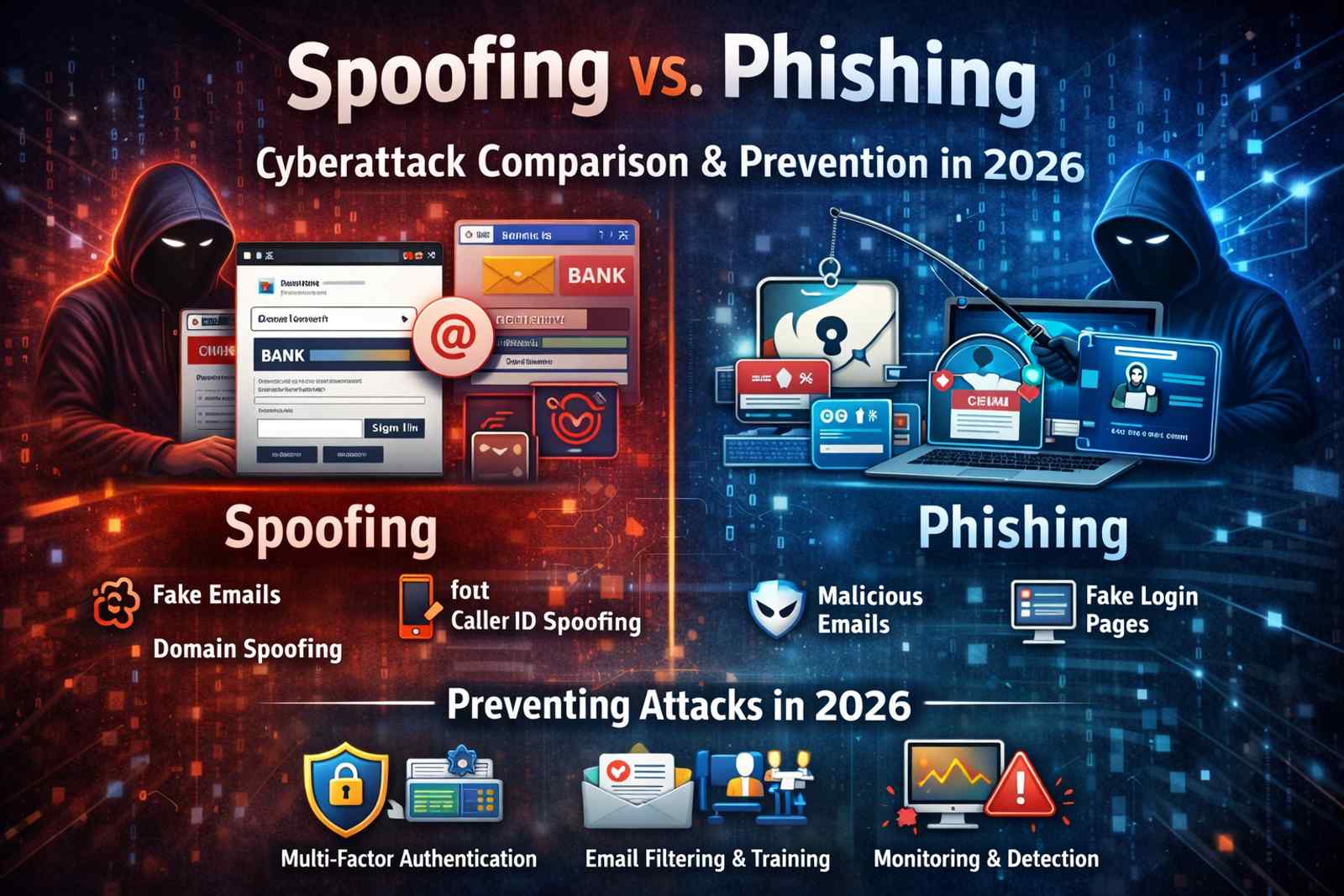
Cybercriminals are becoming more sophisticated every year.
Two of the most common attack methods organizations face today are spoofing and phishing. While the terms are often used interchangeably, they are not the same thing.
Understanding the difference is critical for protecting your organization from credential theft, financial fraud, and data breaches.
In 2026, as AI-generated attacks increase in realism and scale, businesses must know exactly what they are defending against.
Quick Answer: How Does Spoofing Differ From Phishing?
Phishing is a social engineering attack designed to trick individuals into revealing sensitive information such as passwords or financial data.
Spoofing is the act of falsifying the identity of a sender, website, phone number, or system to make an attack appear legitimate.
Spoofing is often used as a technique within phishing attacks, but spoofing can also occur on its own.
What Is Phishing?
Phishing is a cyberattack that manipulates people into giving up confidential information.
According to the Federal Bureau of Investigation Internet Crime Complaint Center, phishing remains one of the most reported cybercrimes each year.
Phishing attacks typically involve:
- Fraudulent emails pretending to be from trusted organizations
- Fake login pages designed to steal credentials
- Malicious links or attachments
- Urgent or threatening language to pressure action
The Cybersecurity and Infrastructure Security Agency explains that phishing attacks rely on deception and social engineering rather than technical hacking alone.
The goal of phishing is simple: convince the victim to act.
What Is Spoofing?
Spoofing is the act of disguising communication from an unknown source as being from a known, trusted source.
Spoofing can occur across multiple channels, including:
- Email spoofing
- Caller ID spoofing
- Website spoofing
- IP address spoofing
- GPS spoofing
The Federal Trade Commission warns that spoofing often makes fraudulent communications appear legitimate by altering caller ID, domain names, or sender information:
Spoofing by itself does not always request information. Instead, it creates the illusion of legitimacy.
How Spoofing and Phishing Work Together
Spoofing is frequently used as a delivery mechanism for phishing.
For example:
- A cybercriminal spoofs a company executive’s email address.
- An employee receives what appears to be a legitimate internal message.
- The message asks the employee to click a link or transfer funds.
- The employee complies, believing the message is authentic.
In this case, spoofing creates trust. Phishing exploits that trust.
Together, they significantly increase the likelihood of success.
Key Differences Between Spoofing and Phishing
While related, spoofing and phishing have different purposes.
Intent:
- Phishing aims to steal information or money.
- Spoofing aims to impersonate a trusted source.
Method:
- Phishing uses deceptive messaging to manipulate behavior.
- Spoofing falsifies technical identifiers like email headers or phone numbers.
Outcome:
- Phishing results in stolen credentials, data, or funds.
- Spoofing increases credibility and bypasses initial suspicion.
Understanding this distinction helps organizations implement layered defenses.
Why These Attacks Are Increasing in 2026
AI-generated content has made phishing emails more convincing than ever.
The FBI has warned about cybercriminals using AI to enhance fraud schemes, including highly personalized phishing campaigns.
Common trends include:
- Perfect grammar and professional formatting
- Personalized messages based on social media data
- Deepfake voice spoofing in phone scams
- AI-generated fake websites
These tactics reduce the obvious red flags that employees once relied on.
The Business Impact of Phishing and Spoofing
Successful attacks can lead to:
- Credential theft
- Ransomware deployment
- Financial wire fraud
- Data breaches
- Regulatory penalties
- Reputational damage
According to IBM’s Cost of a Data Breach Report, stolen credentials remain one of the most common initial attack vectors
The financial impact can be severe, especially for regulated industries.
How Organizations Can Prevent Spoofing and Phishing Attacks
Preventing these attacks requires both technical controls and employee awareness.
Effective prevention strategies include:
- Multi-factor authentication to reduce credential misuse
- Email authentication protocols such as SPF, DKIM, and DMARC
- Advanced email filtering and threat detection
- Continuous security awareness training
- Regular phishing simulations
- Monitoring for domain impersonation
CISA recommends enabling multi-factor authentication and strengthening email security configurations as primary defenses.
Technology reduces risk, but trained employees are often the last line of defense.
Why Security Awareness Training Is Critical
Employees must know how to identify suspicious behavior, including:
- Slightly altered domain names
- Unexpected urgent payment requests
- Login pages with unusual URLs
- Requests for confidential data
Consistent training reduces the likelihood of successful phishing and spoofing attacks.
Organizations that combine technical safeguards with employee education significantly lower breach risk.
How TechGuard Helps Protect Against Phishing and Spoofing
TechGuard helps organizations strengthen defenses against modern social engineering attacks.
Our services include:
- Risk assessments aligned with NIST frameworks
- Email security configuration and monitoring
- Multi-factor authentication implementation
- Security awareness training programs
- Incident response planning
- Continuous monitoring solutions
Learn more about TechGuard’s cybersecurity services.
Ready to Reduce Your Risk of Social Engineering Attacks?
Spoofing and phishing attacks are evolving rapidly, especially as AI lowers the barrier for cybercriminals.
Organizations that proactively strengthen authentication, monitoring, and employee awareness are far less likely to suffer costly breaches.
Contact TechGuard to schedule a cybersecurity risk assessment.
FAQ: Spoofing and Phishing
Is spoofing always part of phishing?
No. Spoofing can occur independently, but it is commonly used to support phishing attacks.
Which is more dangerous, spoofing or phishing?
Phishing typically causes direct damage because it aims to steal credentials or money. Spoofing increases the likelihood that phishing will succeed.
Can multi-factor authentication stop phishing?
It significantly reduces risk by preventing attackers from accessing accounts even if credentials are stolen.
How often should employees receive phishing training?
At minimum annually, though quarterly reinforcement and simulated phishing exercises provide stronger protection.